Publications
Abstract
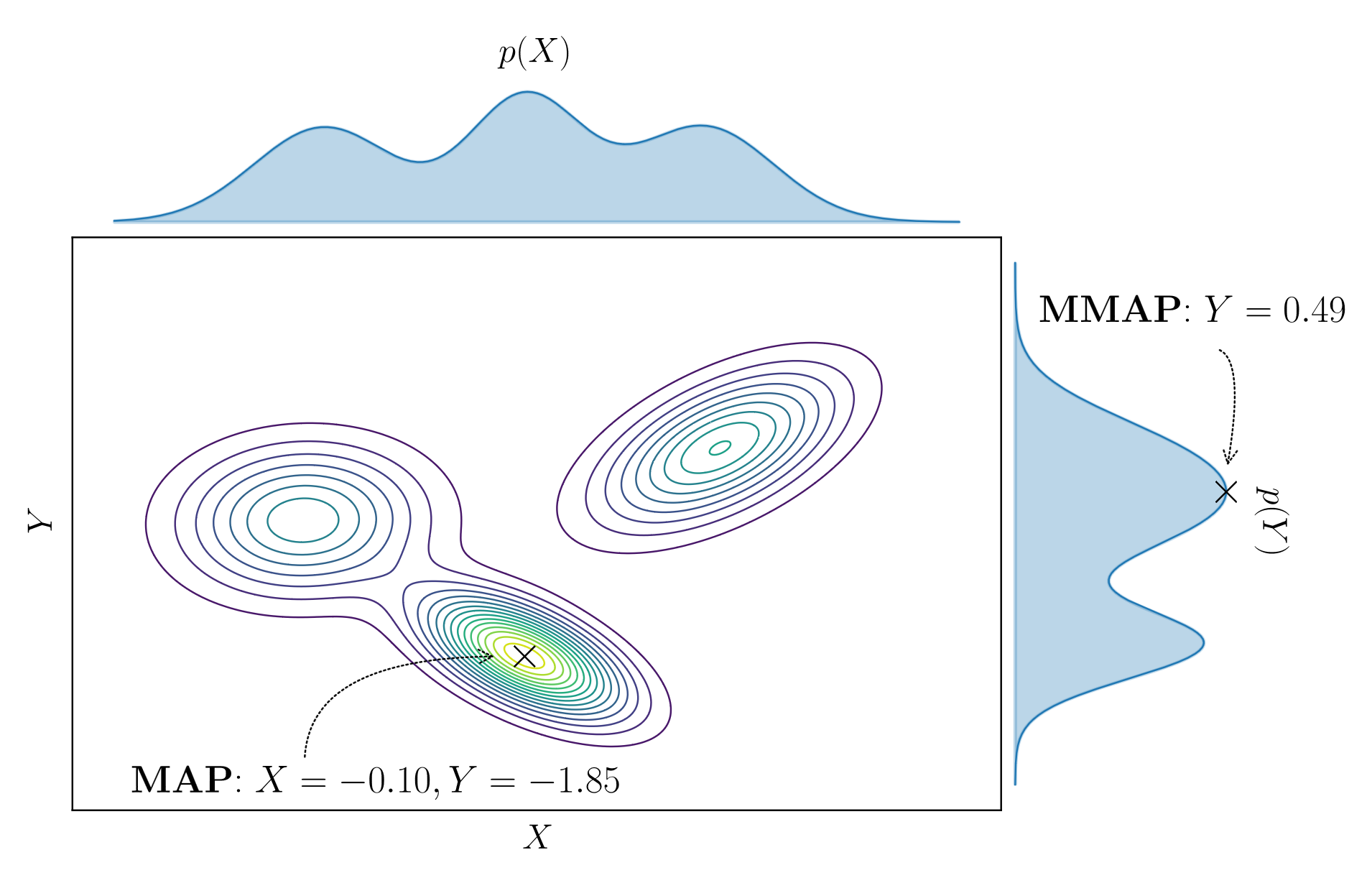
Deep neural networks (DNNs) have achieved remarkable success in learning complex functions from data, yet they often lack the principled probabilistic reasoning and tractability of models like probabilistic circuits (PCs). This creates a fundamental dichotomy in modern machine learning, putting the expressiveness and scalability of DNNs against the inference flexibility and probabilistic benefits of PCs. This dissertation aims to bridge this divide through a two-sided research agenda: first, by advancing the capabilities of PCs through the integration of deep learning principles, and second, by leveraging probabilistic models as components within the broader deep learning ecosystem to create more robust and capable hybrid systems.
To address the limitations of PCs, we first introduce einsum networks, a tensorized framework that reformulates circuit computations to enable scalable, hardware-accelerated training, yielding orders-of-magnitude speedups. We then develop a differentiable sampling procedure that enables the use of arbitrary, sample-based training objectives, moving PCs beyond traditional maximum likelihood estimation. Finally, we propose tractable dropout inference (TDI), a novel, closed-form method to quantify epistemic uncertainty in a single forward pass, enabling PCs to reliably detect out-of-distribution data.
Building on these advancements, we shift focus from enhancing PCs to leveraging them in collaboration with DNNs. We introduce autoencoding probabilistic circuits (APCs), a hybrid architecture that pairs a tractable PC encoder with a neural decoder. By modeling the joint data-embedding distribution, APCs achieve principled representation learning and are uniquely robust to missing data through exact marginalization. Extending this approach beyond hybrid architectures, we reframe knowledge distillation from a probabilistic viewpoint, leading to contrastive abductive knowledge extraction (CAKE), a fully data-free and model-agnostic procedure for deep classifier mimicry.
Collectively, these contributions demonstrate that PCs and DNNs are not mutually exclusive paradigms but rather complementary approaches that can be combined to create more capable and robust models. This work provides a computational and conceptual contribution for developing hybrid systems that unite the representational power of deep learning with the rigorous, tractable inference of probabilistic models, paving the way for more robust, flexible, and reliable artificial intelligence.
BibTeX
@phdthesis{braun2026dissertation,
  title    = {Bridging Probabilistic Circuits and Deep Neural Networks},
  author   = {Braun, Steven},
  year     = {2026},
  month    = {feb},
  school   = {Technische Universität Darmstadt},
  address  = {Darmstadt},
  note     = {Ph.D. Thesis, Primary publication},
  doi      = {10.26083/tuda-7775},
  url      = {https://tuprints.ulb.tu-darmstadt.de/handle/tuda/15123},
  urn      = {urn:nbn:de:tuda-tuda-151233},
  language = {English}
}
Abstract
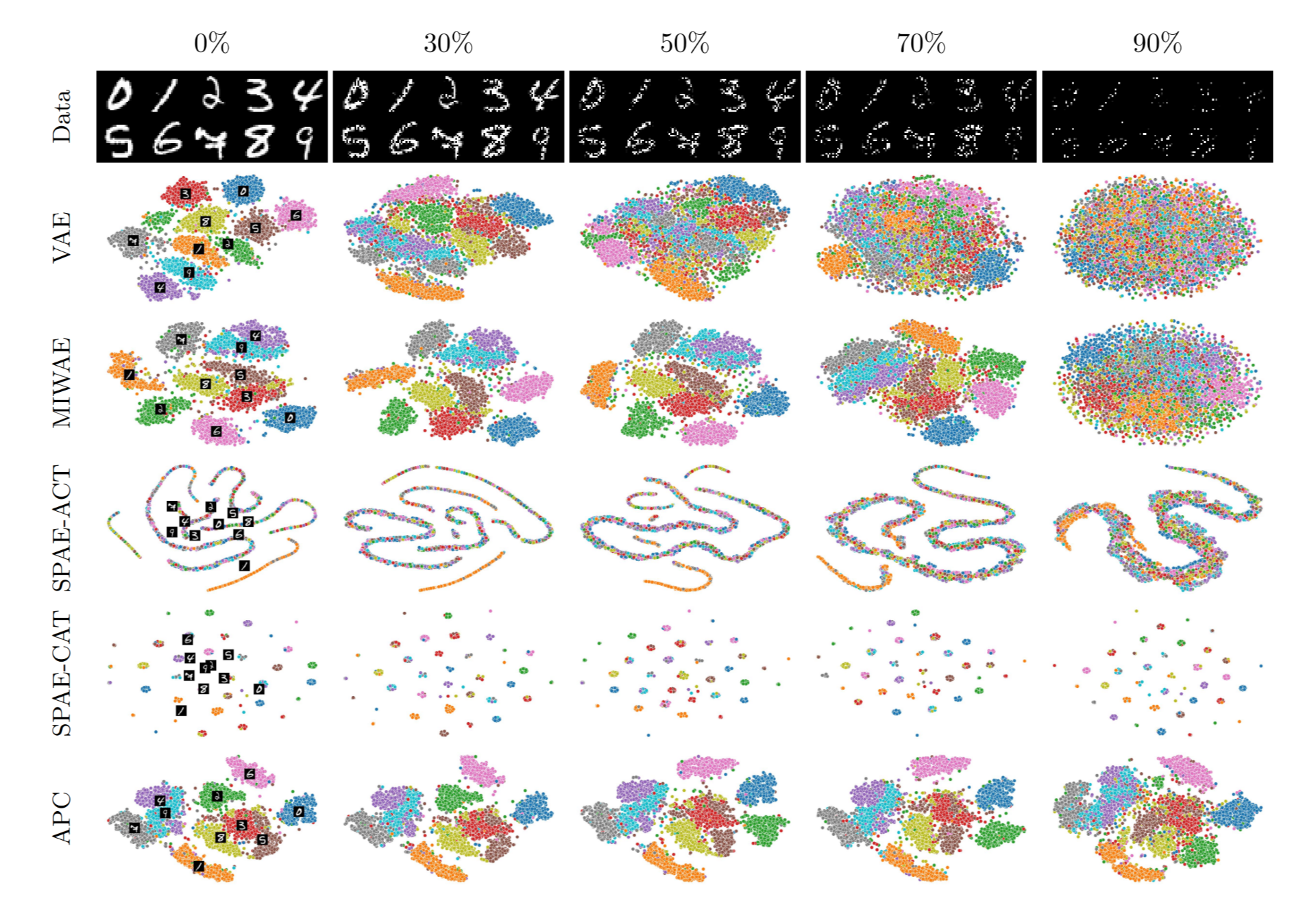
Probabilistic circuits (PCs) are powerful probabilistic models that enable exact and tractable inference, making them highly suitable for probabilistic reasoning and inference tasks. While dominant in neural networks, representation learning with PCs remains underexplored, with prior approaches relying on external neural embeddings or activation-based encodings. To address this gap, we introduce autoencoding probabilistic circuits (APCs), a novel framework leveraging the tractability of PCs to model probabilistic embeddings explicitly. APCs extend PCs by jointly modeling data and embeddings, obtaining embedding representations through tractable probabilistic inference. The PC encoder allows the framework to natively handle arbitrary missing data and is seamlessly integrated with a neural decoder in a hybrid, end-to-end trainable architecture enabled by differentiable sampling. Our empirical evaluation demonstrates that APCs outperform existing PC-based autoencoding methods in reconstruction quality, generate embeddings competitive with, and exhibit superior robustness in handling missing data compared to neural autoencoders. These results highlight APCs as a powerful and flexible representation learning method that exploits the probabilistic inference capabilities of PCs, showing promising directions for robust inference, out-of-distribution detection, and knowledge distillation.
BibTeX
@article{braun2025apcs,
  title   = {Tractable Representation Learning with Probabilistic Circuits},
  author  = {Steven Braun and Sahil Sidheekh and Antonio Vergari and Martin Mundt and Sriraam Natarajan and Kristian Kersting},
  year    = {2025},
  journal = {Transactions on Machine Learning Research}
}
Abstract
Access to pre-trained models has recently emerged as a standard across numerous machine learning domains. Unfortunately, access to the original data the models were trained on may not equally be granted. This makes it tremendously challenging to fine-tune, compress models, adapt continually, or to do any other type of data-driven update. We posit that original data access may however not be required. Specifically, we propose Contrastive Abductive Knowledge Extraction (CAKE), a model-agnostic knowledge distillation procedure that mimics deep classifiers without access to the original data. To this end, CAKE generates pairs of noisy synthetic samples and diffuses them contrastively toward a model's decision boundary. We empirically corroborate CAKE's effectiveness using several benchmark datasets and various architectural choices, paving the way for broad application.
BibTeX
@article{braun2023cake,
  title   = {Deep Classifier Mimicry without Data Access},
  author  = {Steven Braun and Martin Mundt and Kristian Kersting},
  year    = {2024},
  journal = {International Conference on Artificial Intelligence and Statistics (AISTATS) -- Oral & Student Paper Highlight Award}
}
Abstract
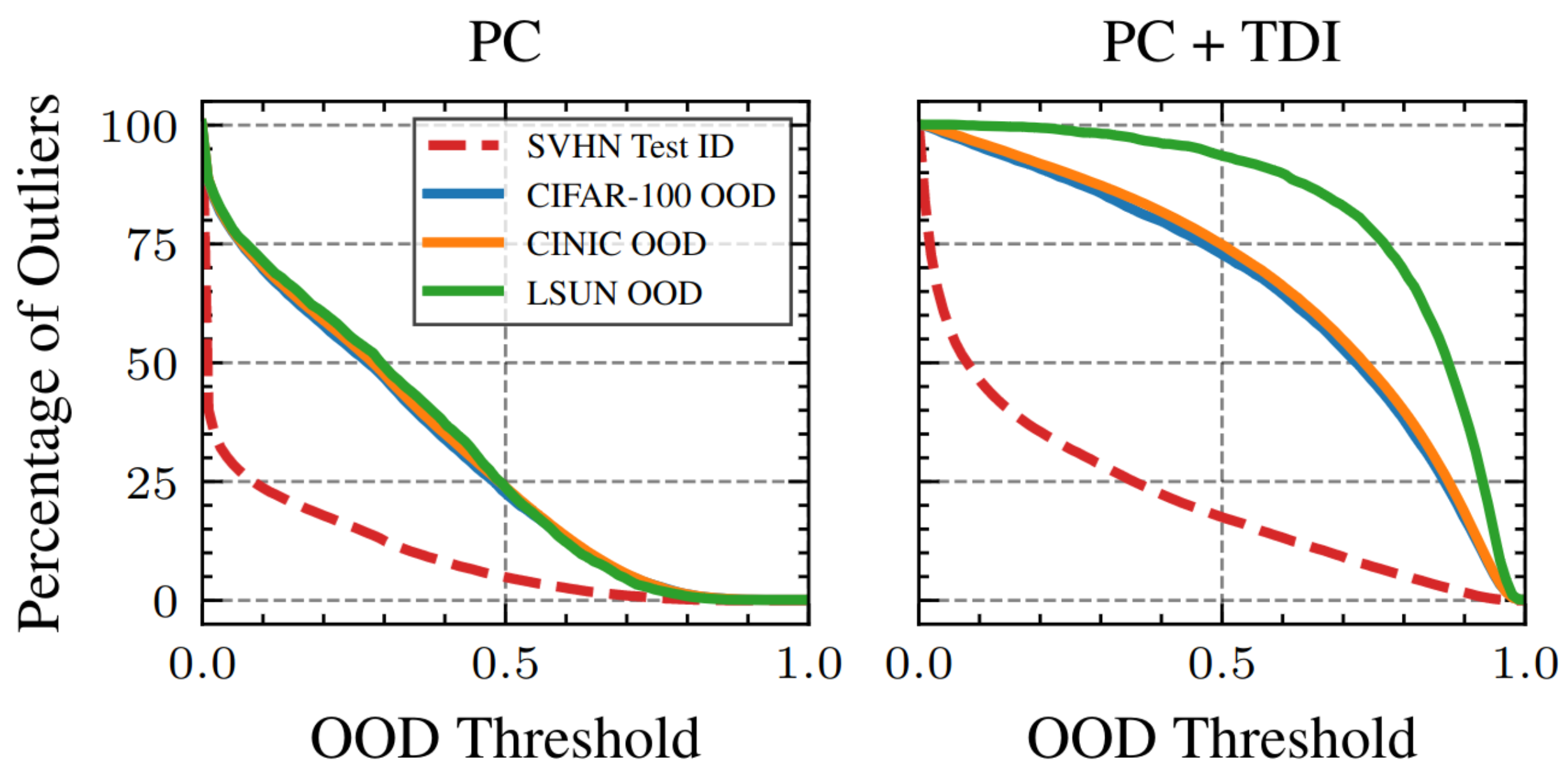
Probabilistic circuits (PCs) are models that allow exact and tractable probabilistic inference. In contrast to neural networks, they are often assumed to be well-calibrated and robust to out-of-distribution (OOD) data. In this paper, we show that PCs are in fact not robust to OOD data, i.e., they don't know what they don't know. We then show how this challenge can be overcome by model uncertainty quantification. To this end, we propose tractable dropout inference (TDI), an inference procedure to estimate uncertainty by deriving an analytical solution to Monte Carlo dropout (MCD) through variance propagation. Unlike MCD in neural networks, which comes at the cost of multiple network evaluations, TDI provides tractable sampling-free uncertainty estimates in a single forward pass. TDI improves the robustness of PCs to distribution shift and OOD data, demonstrated through a series of experiments evaluating the classification confidence and uncertainty estimates on real-world data.
BibTeX
@article{braun2023tdi,
  author  = {Ventola*, Fabrizio and Braun*, Steven and Yu, Zhongjie and Mundt, Martin and Kersting, Kristian},
  title   = {Probabilistic Circuits That Know What They Don't Know},
  year    = {2023},
  journal = {Proceedings of the 39th Conference on Uncertainty in Artificial Intelligence (UAI)}
}
Abstract
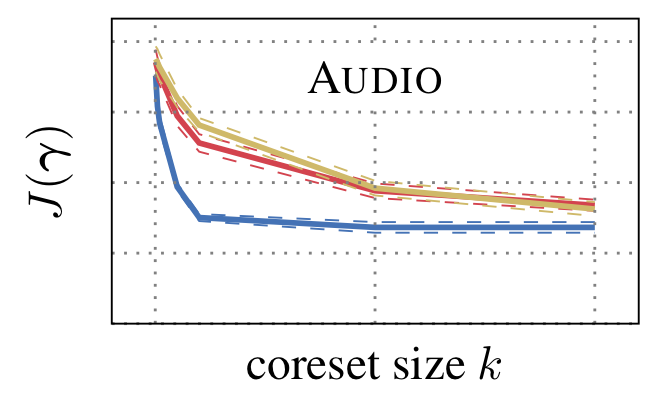
Probabilistic circuits (PCs) are a powerful family of tractable probabilistic models, guaranteeing efficient and exact computation of many probabilistic inference queries. However, their sparsely structured nature makes computations on large data sets challenging to perform. Recent works have focused on tensorized representations of PCs to speed up computations on large data sets. In this work, we present an orthogonal approach by sparsifying the set of $n$ observations and show that finding a coreset of $k\ll n$ data points can be phrased as a monotone submodular optimisation problem which can be solved greedily for a deterministic PCs of $|\G|$ nodes in $\mathcal{O}(k \, n \, |\G|)$. Finally, we verify on a series of data sets that our greedy algorithm outperforms random selection.
BibTeX
@inproceedings{trapp2022towards,
  title     = {Towards Coreset Learning in Probabilistic Circuits},
  author    = {Martin Trapp and Steven Lang and Aastha Shah and Martin Mundt and Kristian Kersting and Arno Solin},
  booktitle = {The 5th Workshop on Tractable Probabilistic Modeling (UAI)},
  year      = {2022}
}
Abstract
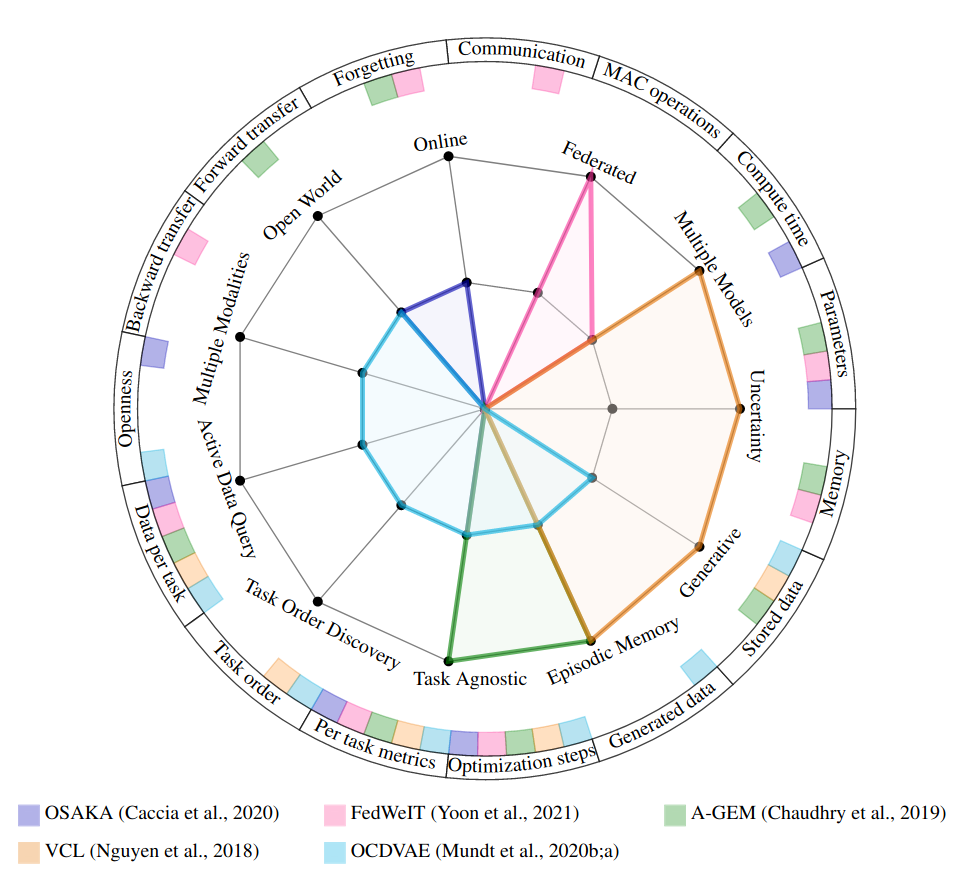
What is the state of the art in continual machine learning? Although a natural question for predominant static benchmarks, the notion to train systems in a life- long manner entails a plethora of additional challenges with respect to set-up and evaluation. The latter have recently sparked a growing amount of critiques on prominent algorithm-centric perspectives and evaluation protocols being too nar- row, resulting in several attempts at constructing guidelines in favor of specific desiderata or arguing against the validity of prevalent assumptions. In this work, we depart from this mindset and argue that the goal of a precise formulation of desiderata is an ill-posed one, as diverse applications may always warrant distinct scenarios. Instead, we introduce the Continual Learning EValuation Assessment Compass: the CLEVA-Compass. The compass provides the visual means to both identify how approaches are practically reported and how works can simultane- ously be contextualized in the broader literature landscape. In addition to promot- ing compact specification in the spirit of recent replication trends, it thus provides an intuitive chart to understand the priorities of individual systems, where they resemble each other, and what elements are missing towards a fair comparison.
BibTeX
@inproceedings{mundt2021clevacompass,
  title     = {CLEVA-Compass: A Continual Learning EValuation Assessment Compass to Promote Research Transparency and Comparability},
  author    = {Martin Mundt and Steven Lang and Quentin Delfosse and Kristian Kersting},
  year      = {2022},
  booktitle = {International Conference on Learning Representations (ICLR)}
}

Abstract
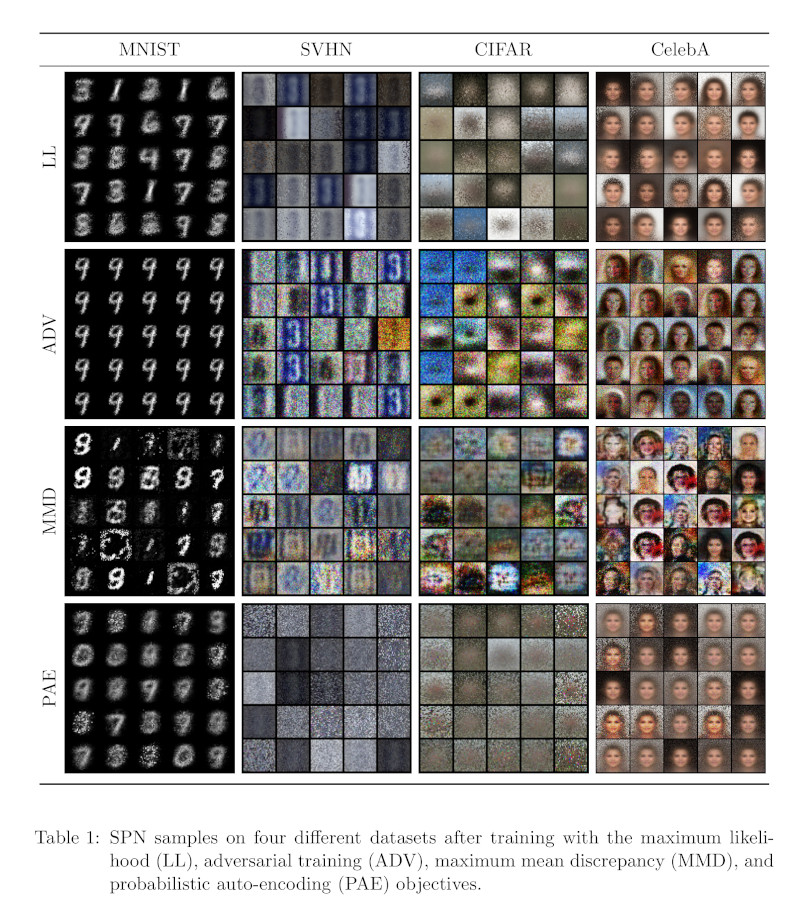
Deep generative models have seen a dramatic improvement in recent years, due to the use of alternative losses based on perceptual assessment of generated samples. This improvement has not yet been applied to the model class of probabilistic circuits (PCs), presumably due to significant technical challenges concerning differentiable sampling, which is a key requirement for optimizing perceptual losses. This is unfortunate, since PCs allow a much wider range of probabilistic inference routines than main-stream generative models, such as exact and efficient marginalization and conditioning. Motivated by the success of loss reframing in deep generative models, we incorporate perceptual metrics into the PC learning objective. To this aim, we introduce a differentiable sampling procedure for PCs, where the central challenge is the non-differentiability of sampling from the categorical distribution over latent PC variables. We take advantage of the Gumbel-Softmax trick and develop a novel inference pass to smoothly interpolate child samples as a strategy to circumvent non-differentiability of sum node sampling. We initially hypothesized, that perceptual losses, unlocked by our novel differentiable sampling procedure, will elevate the generative power of PCs and improve their sample quality to be on par with neural counterparts like probabilistic auto-encoders and generative adversarial networks. Although our experimental findings empirically reject this hypothesis for now, the results demonstrate that samples drawn from PCs optimized with perceptual losses can have similar sample quality compared to likelihood-based optimized PCs and, at the same time, can express richer contrast, colors, and details. Whereas before, PCs were restricted to likelihood-based optimization, this work has paved the way to advance PCs with loss formulations that have been built around deep neural networks in recent years.
BibTeX
@inproceedings{lang2022diff-sampling-spns,
  title     = {Elevating Perceptual Sample Quality in Probabilistic Circuits through Differentiable Sampling},
  author    = {Steven Lang and Martin Mundt and Fabrizio Ventola and Robert Peharz and Kristian Kersting},
  booktitle = {Proceedings of Machine Learning Research, Workshop on Preregistration in Machine Learning (NeurIPS)},
  year      = {2022},
  volume    = {181},
  series    = {Proceedings of Machine Learning Research},
  pages     = {1--25},
  publisher = {PMLR}
}
Abstract
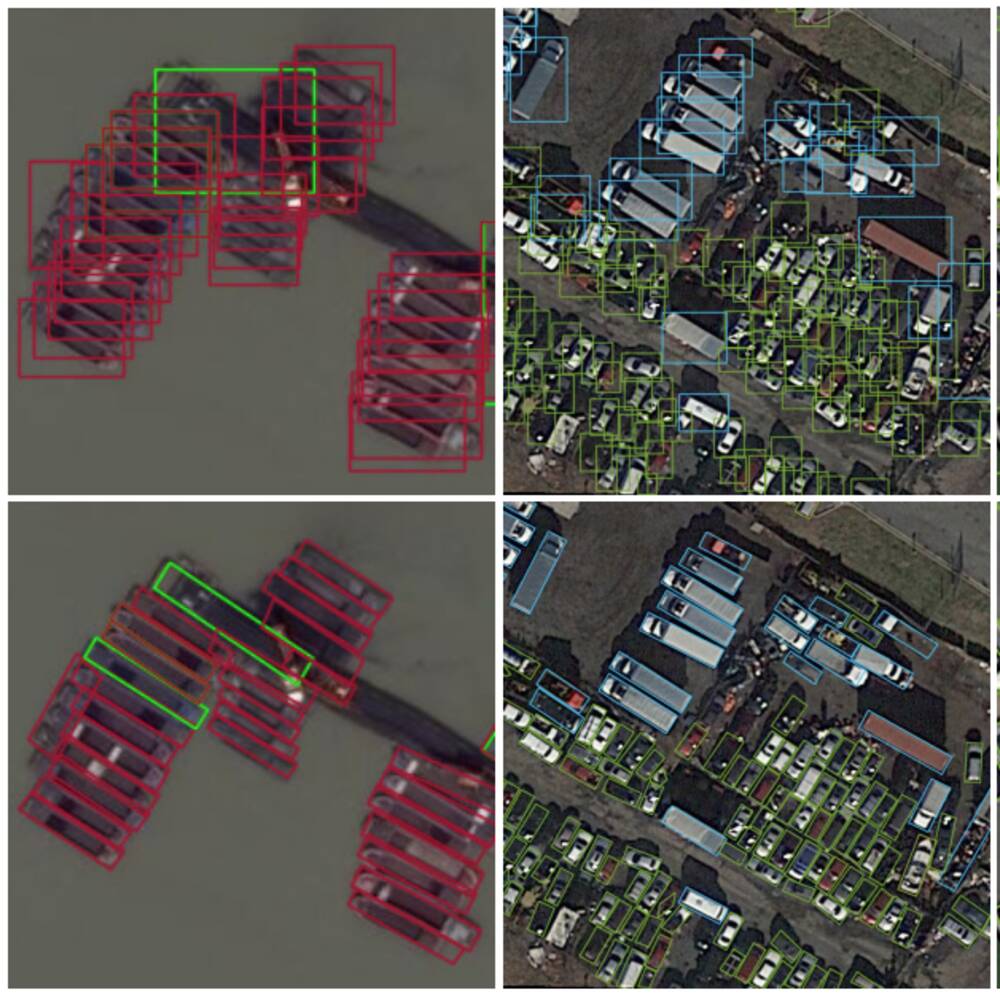
We present DAFNe, a Dense one-stage Anchor-Free deep Network for oriented object detection. As a one-stage model, it performs bounding box predictions on a dense grid over the input image, being architecturally simpler in design, as well as easier to optimize than its two-stage counterparts. Furthermore, as an anchor-free model, it reduces the prediction complexity by refraining from employing bounding box anchors. With DAFNe we introduce an orientation-aware generalization of the center-ness function for arbitrarily oriented bounding boxes to down-weight low-quality predictions and a center-to-corner bounding box prediction strategy that improves object localization performance. Our experiments show that DAFNe outperforms all previous one-stage anchor-free models on DOTA 1.0, DOTA 1.5, and UCAS-AOD and is on par with the best models on HRSC2016.
BibTeX
@article{lang2021dafne,
  title         = {DAFNe: A One-Stage Anchor-Free Deep Model for Oriented Object Detection},
  author        = {Steven Lang and Fabrizio Ventola and Kristian Kersting},
  year          = {2021},
  eprint        = {2109.06148},
  archiveprefix = {arXiv},
  primaryclass  = {cs.CV},
  journal       = {arXiv preprint, arXiv:2109.06148}
}
Abstract
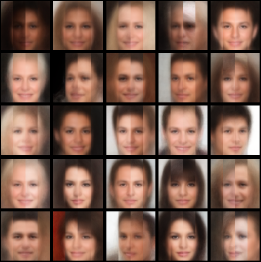
Probabilistic circuits (PCs) are a promising av- enue for probabilistic modeling, as they permit a wide range of exact and efficient inference rou- tines. Recent “deep-learning-style” implementa- tions of PCs strive for a better scalability, but are still difficult to train on real-world data, due to their sparsely connected computational graphs. In this paper, we propose Einsum Networks (EiNets), a novel implementation design for PCs, improving prior art in several regards. At their core, EiNets combine a large number of arithmetic operations in a single monolithic einsum-operation, leading to speedups and memory savings of up to two orders of magnitude, in comparison to previous implementations. As an algorithmic contribution, we show that the implementation of Expectation- Maximization (EM) can be simplified for PCs, by leveraging automatic differentiation. Further- more, we demonstrate that EiNets scale well to datasets which were previously out of reach, such as SVHN and CelebA, and that they can be used as faithful generative image models.
BibTeX
@inproceedings{pmlr-v119-peharz20a,
  title     = {Einsum Networks: Fast and Scalable Learning of Tractable Probabilistic Circuits},
  author    = {Peharz, Robert and Lang, Steven and Vergari, Antonio and Stelzner, Karl and Molina, Alejandro and Trapp, Martin and Van Den Broeck, Guy and Kersting, Kristian and Ghahramani, Zoubin},
  booktitle = {Proceedings of the 37th International Conference on Machine Learning (ICML)},
  pages     = {7563--7574},
  year      = {2020},
  editor    = {Hal Daumé III and Aarti Singh},
  volume    = {119},
  series    = {Proceedings of Machine Learning Research},
  publisher = {PMLR},
  url       = {http://proceedings.mlr.press/v119/peharz20a.html}
}
Abstract
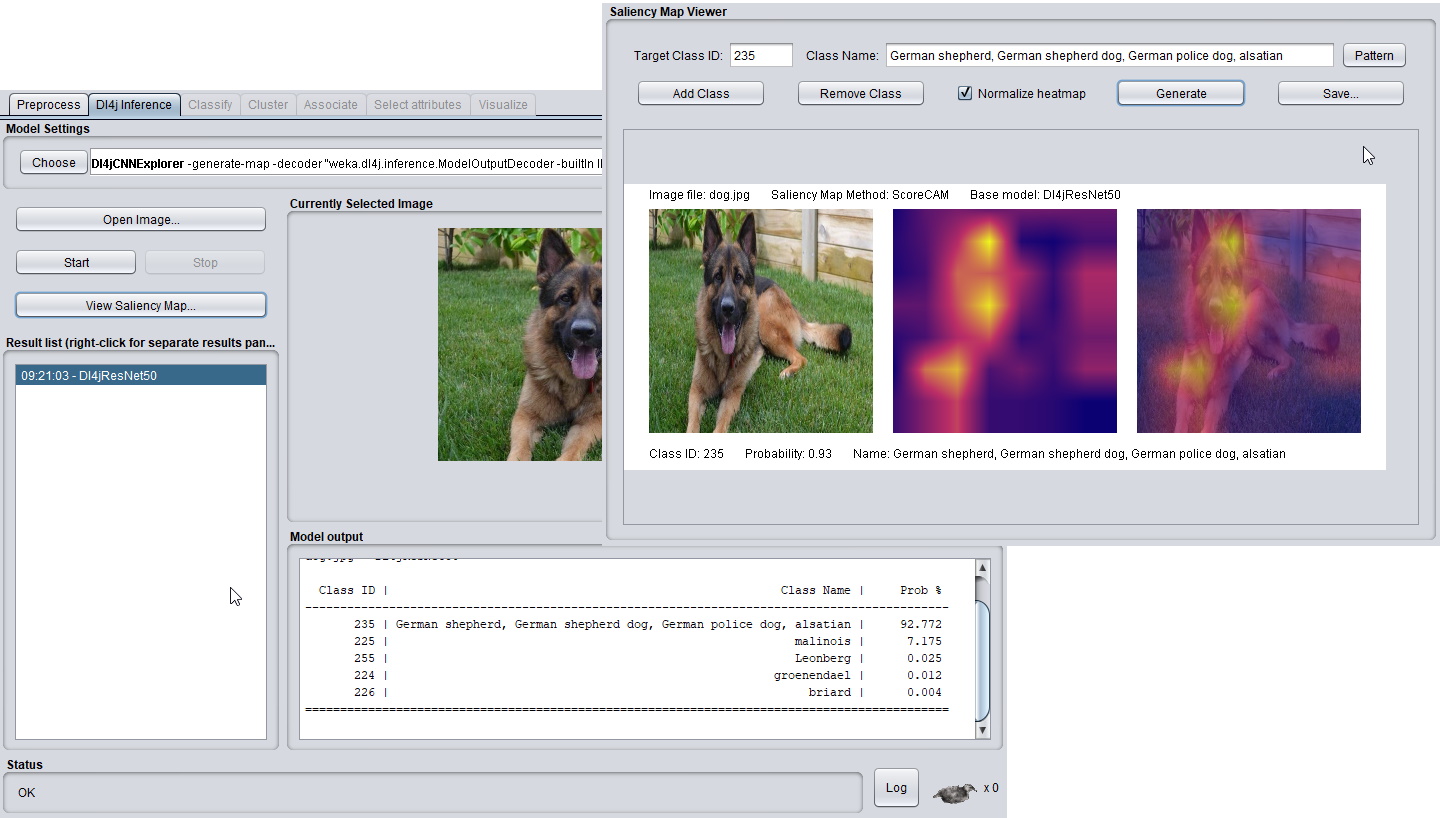
Deep learning is a branch of machine learning that generates multi-layered representations of data, commonly using artificial neural networks, and has improved the state-of-the-art in various machine learning tasks (e.g., image classification, object detection, speech recognition, and document classifica- tion). However, most popular deep learning frameworks such as TensorFlow and PyTorch require users to write code to apply deep learning. We present WekaDeeplearning4j, a Weka package that makes deep learning accessible through a graphical user interface (GUI). The package uses Deeplearning4j as its backend, provides GPU support, and enables GUI-based training of deep neural networks such as convolutional and recurrent neural networks. It also provides pre-processing functionality for image and text data.
BibTeX
@article{lang2019wekadeeplearning4j,
  title     = {WekaDeeplearning4j: A deep learning package for Weka based on Deeplearning4j},
  author    = {Lang, Steven and Bravo-Marquez, Felipe and Beckham, Christopher and Hall, Mark and Frank, Eibe},
  journal   = {Knowledge-Based Systems},
  volume    = {178},
  pages     = {48 - 50},
  year      = {2019},
  issn      = {0950-7051},
  doi       = {https://doi.org/10.1016/j.knosys.2019.04.013},
  url       = {http://www.sciencedirect.com/science/article/pii/S0950705119301789},
  publisher = {Elsevier}
}
* denotes equal contribution. Download all as BibTeX · Google Scholar